
This is a follow-up article to The Art of Re-Creation. If you haven’t read that essay yet, I recommend you start there. Both of these articles are excerpts from my upcoming book The Sovereign Artist: The liberating power of the creative act.
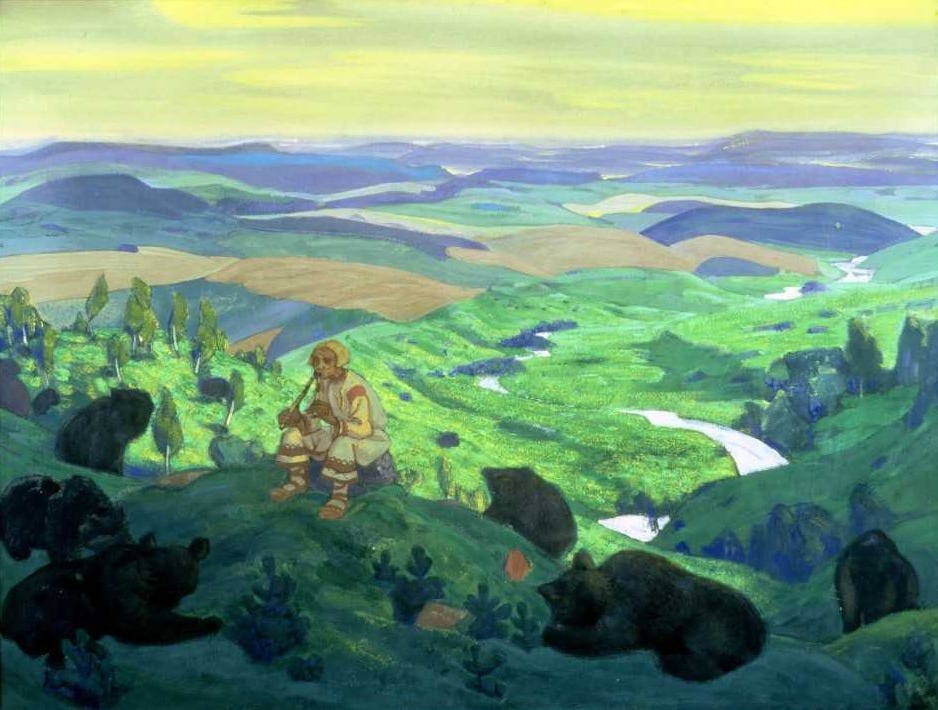
The mind is sharper and keener in seclusion and uninterrupted solitude. No big laboratory is needed in which to think. Originality thrives in seclusion free of outside influences beating upon us to cripple the creative mind. Be alone, that is the secret of invention; be alone, that is when ideas are born. That is why many of the earthly miracles have had their genesis in humble surroundings.
— Nikola Tesla
We’ve discussed that entering the heart of creativity involves following wonder and divine inspiration. By following that spark that is striving, through you, to share its story, you’re attempting to bring into being something extraordinary that the world has never before seen. And to truly achieve this, you must enter that divine state of flow and play in the eddies of the creative waters as they swirl around you.
Doing this often requires entering into long stretches of solitude — time when you can allow ideas to arrive; time when you can simply contemplate; time when you can listen for the muse’s whisper.
I want to briefly mention meditation. Nothing helped me hear the call of my soul more than meditation. It is the ultimate state of solitude; the ultimate state of listening; the ultimate way to see through illusion; the ultimate process of deprogramming; and the ultimate state of connecting with the sacred. Please consider trying it. It has the power to infuse all of your work with fresh insights and creativity. Meditation is the practice that brought me out of my dark night and I still meditate regularly to this day. I discuss meditation a bit more in Appendix I.1
Whatever methods of solitude you choose, the times that you create or re-create are sacred and must be protected. Interruptions kill the flow state and the flow state is necessary to produce extraordinary work. I truly believe interruptions are the most dangerous thing any artist faces.
Your family may mean well when they pop in and ask you what you want for lunch, but they may knock you out of an inspired state that you can’t get back into. Perhaps this danger is why Julia Cameron, in The Artist’s Way, required that the weekly artist date be undertaken by the artist alone.
The Muse is your paramour. She is private and for you alone, and she may flee if another person gets involved. You must guard her jealously, particularly in the early stages of creation which often arrives during our renewal periods. Constant interruptions, especially, are dangerous because your energy will be diverted toward the wrong things, and that may leave you depleted and tired when it’s time to create.
True art often requires long stretches of uninterrupted time in your studio, so you must set limits to protect your (re)creative time.
An artist must have downtime, time to do nothing. Defending our right to such time takes courage, conviction, and resiliency. Such time, space, and quiet will strike our family and friends as a withdrawal from them. It is.
— Julia Cameron, The Artist’s Way
If you don’t protect your time, you will struggle to master your craft and produce enough sale-able work. Nearly all of the great creatives I know treat their studio time like a nine-to-five job, and during their regular hours (whatever those hours may be), rain or shine, inspired or not, they set aside that sacred dedicated time for themselves.
Do whatever you must to protect your creative time. You have to be very selfish to be original.
— Miles Davis
My wife and I once experienced this professional devotion to regular hours firsthand while visiting the painter Kevin Macpherson at his home near Taos, New Mexico. At breakfast one morning he politely explained that although we were on vacation, he was not. He would be in his studio until five o’clock and asked that we not interrupt him unless it was an emergency.
His studio stood a short walk from the house. The mountains were beautiful, the day was perfect, and he surely would have enjoyed joining us for a bike ride through the hills. But he didn’t. His studio time was sacred.
The professional artist understands that creative time is holy. Once lost, it cannot be recovered.
If you want to produce enough masterful, inspired works, which is what it takes to be successful, you must be just as protective of your creative time as Kevin is of his.
PS — Next time we’ll look at the other primary method of re-creation: Nature. In the meantime, if these topics interest you, please click here to join the waitlist for my forthcoming book.

If you would like to support my writing, please take out a premium subscription (just $6 per month).
If you’d like to support my writing, but can’t join as a paid subscriber please click Like, or Restack which signals the algorithm and helps me reach new people. This also helps push back against the encroachment of AI because I do not write with AI and I only feature human artists (with proper links and attribution) in the images with my posts.
AI Image Policy: I only rarely use AI images and overwhelmingly feature images by human artists. On the rare occasions I do use an AI image (usually fiction), I also feature at least one artwork by a human artist with image credits and links to their work or, if I can’t find a suitable image, I donate a free month of website service to one of our artist customers at my SaaS company, FASO Artist Websites.
Poetic expression, spiritual ideas, and musings upon beauty, truth and goodness should be free to spread far and wide. Hence, I have not paywalled the work on Clinsights. However, if you’re able to become a paid subscriber, I’d be eternally grateful. It would help, encourage and enable me to continue exploring these topics and allow me to keep it accessible for a world that is in desperate need of beauty, truth, goodness and love. — Creatively, Clintavo.
Appendix I: Methods of Re-Creation appears in my forthcoming book, The Sovereign Artist, but it is not currently online as it needs further editing.
This post on Solitude is like a perfect acorn to a ADHD squirrel. She puts it in her mouth to carry it and decides it has to be kept where she can stop and look at it whenever. I have had years of squirrel life. 3 kids, several home businesses, full time teaching in public school and church involvements. The years before marriage were full of solitary art production and discovery. All creatives will find expression throughout the busy years, but to carve out solitude is always a heartfelt desire. I did find time during those years and now, in my last quarter, it is time again. Interestingly, years of overlapping obligations and schedules created work habits that are hard to break I recommend that all younger creatives read your posts so as to create the most important habits and life styles early.
This is so so important. I love my sacred alone time to paint and think creatively which I have carved out in my life of 35 years as an artist. I have a difficult time still especially now with family issues and the pull of obligations to convincing family of my sacred needed time. Why few women are not professional artists I believe.